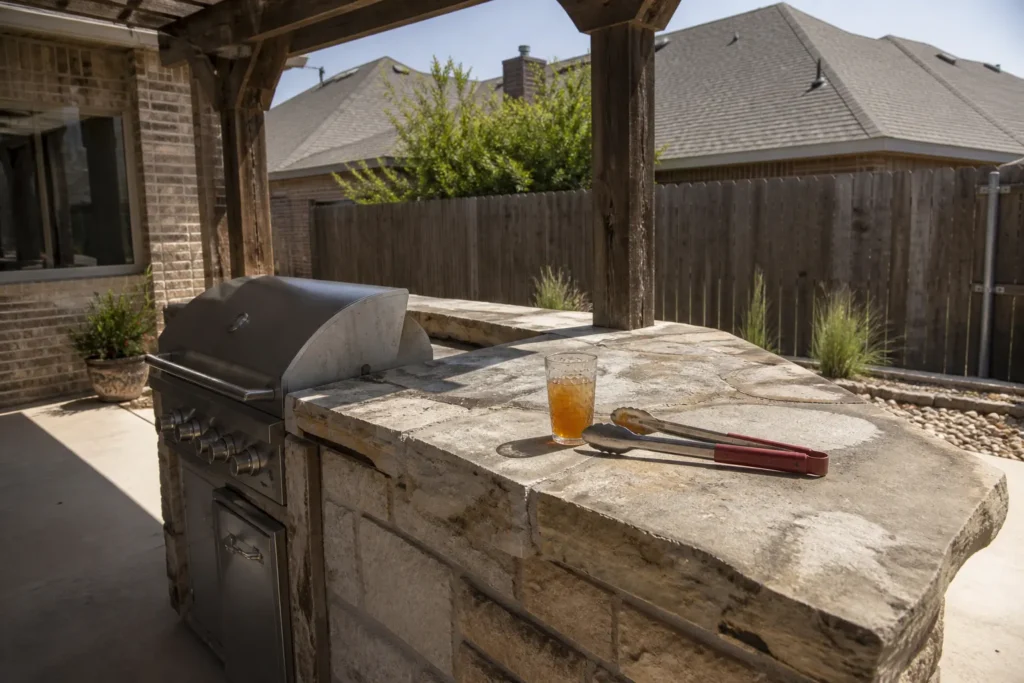
Plano Countertops helps homeowners and businesses across Plano, TX choose, fabricate and install the right countertop. An outdoor kitchen in Plano deals with a combination that few climates produce: 100-plus degree afternoons for weeks at a stretch, intense UV, hailstorms, and occasional hard freezes that can drop well below what anyone plans for. Each of those attacks a different material property.
Get the material right and outdoor countertops need almost no attention. Get it wrong and you will be replacing them in two or three years.
What Texas weather actually does
Heat and UV break down resin
Any material bound with polymer resin will yellow, fade and eventually warp under sustained direct sun and heat. Surface temperatures on a dark counter in full July sun get far higher than air temperature.
Freeze events crack porous stone
A hard freeze after rain pushes water in the pores into ice. North Texas does not freeze often, but when it does it can go deep and stay for days, and that is enough to spall an unsealed porous surface.
Hail chips and cracks
This one is specific to this region and it gets left out of most material guides. Large hail can chip stone edges and crack thinner or more brittle materials. A cover over the outdoor kitchen is worth as much here for hail as for sun.
Thermal shock
A surface at 140 degrees hit by a cold rainstorm experiences real stress. Dense materials handle it; ones with existing hairline flaws sometimes do not.
What works
Granite — the standard answer
Dense, UV-stable, heat-tolerant and readily available across DFW. It needs sealing, and outdoors that means annually rather than every few years. Choose a lighter colour if the counter gets direct sun — a dark granite in July becomes too hot to rest a hand on.
For most Plano outdoor kitchens, granite is the right call.
Porcelain — the best technical performer
Non-porous, fully UV-stable, freeze-proof, stain-proof, and it never needs sealing. Light colours stay light. The caveats are edge fabrication, which is more involved, and impact resistance — a large hailstone or a dropped cast iron pan can chip it.
If you want a pale outdoor counter that will still be pale in ten years, porcelain is the material.
Soapstone
Non-porous, completely heat-indifferent, needs no sealing. It darkens outdoors over time. Scratches sand out with fine paper. A quietly excellent choice that few people consider.
Quartzite
Natural, hard and UV-stable. It needs sealing like granite and costs more, but a quartzite outdoor counter holds up well.
What does not work
Quartz — genuinely not suitable
This trips people up because quartz is such a good indoor material. The resin binder is not UV-stable. Outdoors it fades, yellows and can warp in Texas heat. Essentially every manufacturer excludes outdoor use from the warranty.
A fully shaded north-facing spot is sometimes offered as an exception. In this climate, with ambient UV and 100-degree air temperature, it is not a risk worth taking.
Marble
Porous, etches in rain, stains from anything organic, and vulnerable in a freeze. It works outdoors in a dry Mediterranean climate and not here.
Laminate, butcher block, solid surface, epoxy
Laminate delaminates. Butcher block greys and checks and needs constant oiling. Solid surface softens in heat and is not UV-stable. Epoxy is an indoor material — UV yellows it quickly.
Design details that extend the life
- Build a cover. A pergola with a solid panel or a proper roof addresses sun, hail and rain at once. It is the highest-value decision in the whole project.
- Pitch the surface slightly so water sheds rather than pooling.
- Use a drip edge so rainwater does not run down the cabinet faces.
- Build on masonry or steel. Wood framing outdoors invites rot and termites.
- Respect grill clearances. Every manufacturer specifies minimum distances to combustible and non-combustible surfaces, and they vary.
- Plan for the freeze. If there is a sink, the supply line needs a shutoff and a drain point so it can be winterised. Texas has learned this the hard way.
Maintenance, realistically
Reseal granite or quartzite once a year. Rinse dust off. Check the caulk where the counter meets the grill and any wall each spring. Cover the grill, not the counter — a sealed cover on stone traps moisture underneath.
That is the whole list. Any material needing more than that is the wrong material for a Texas patio.
Our outdoor countertops are specified around these conditions, and the same thinking applies to commercial outdoor installations.
Frequently asked questions
How hot does a dark stone counter get in July?
Hot enough to be genuinely uncomfortable to touch in direct sun. Shade or a lighter colour solves it.
Will hail damage a stone countertop?
Large hail can chip edges. A cover is the practical protection, and it pays for itself in several other ways.
Can I use the same material inside and outside?
With granite, quartzite, porcelain or soapstone, yes. With quartz, no.
Do I need to do anything before a freeze?
Drain any water lines and shut them off. The stone itself will be fine if it is sealed.
Spec it for the summer you actually get
We will recommend materials that handle a Plano July and a Texas freeze. Call (469) 649-8119.