Plano Countertops helps homeowners and businesses across Plano, TX choose, fabricate and install the right countertop. People often pick a bathroom countertop by carrying over whatever they chose for the kitchen. It is a reasonable instinct and it is sometimes wrong, because the two surfaces face different problems.
A vanity sees almost no heat and very little cutting. What it does see is constant water, hairspray, nail polish remover, toothpaste, cosmetics and — in much of the Plano area — hard water depositing minerals around the faucet every single day.
The materials, ranked for a bathroom
Quartz — the strongest all-round choice
Non-porous, so hard water and cosmetics do not soak in. No sealing, ever. Consistent colour, which matters in a small room where the whole top is visible at once. The heat weakness that argues against quartz in a kitchen is close to irrelevant on a vanity — a curling iron will not reach scorching temperature against the surface if it is set on its own rest.
The one real caution is sunlight. A vanity under a large sunny window has the same UV consideration as any quartz surface.
Granite — durable, but needs upkeep
Hard, attractive, widely available, and the small size of a vanity top means remnant pieces are often available at a good price. It needs sealing, and around a hard-water faucet that sealer takes a beating. Descaling products that dissolve mineral deposits will strip it, so the routine is wiping deposits before they set rather than removing them later.
A darker granite handles a bathroom better than a light one.
Porcelain — excellent and often overlooked
Completely non-porous, stain-proof, UV-stable, and available in convincing marble looks. It handles every bathroom chemical without concern. The limits are edge detailing and the fact that a sharp impact can chip it. For a small vanity, porcelain is a very strong option.
Marble — beautiful, and a commitment
A marble vanity is a genuinely lovely thing and it is a much more reasonable proposition in a bathroom than in a kitchen, because there is no lemon juice or red wine. But it still etches — anything acidic dulls the polish, and a surprising number of bathroom products are acidic. Toothpaste, some cleaners, and certain cosmetics all leave marks.
Choose marble if you accept a patina. Do not choose it expecting it to stay pristine.
Solid surface — practical, dated-looking to some
Can be made with an integrated sink and no seam at all, which is genuinely easy to clean. Scratches, but scratches sand out. Not heat-tolerant, which does not matter here.
Limestone and travertine — proceed carefully
Both are porous and reactive. In a powder room that sees light use they can work well and look beautiful. In a main bathroom with daily heavy use, they need more attention than most people will give them. See limestone and travertine for what each involves.
Decisions beyond material
Sink type
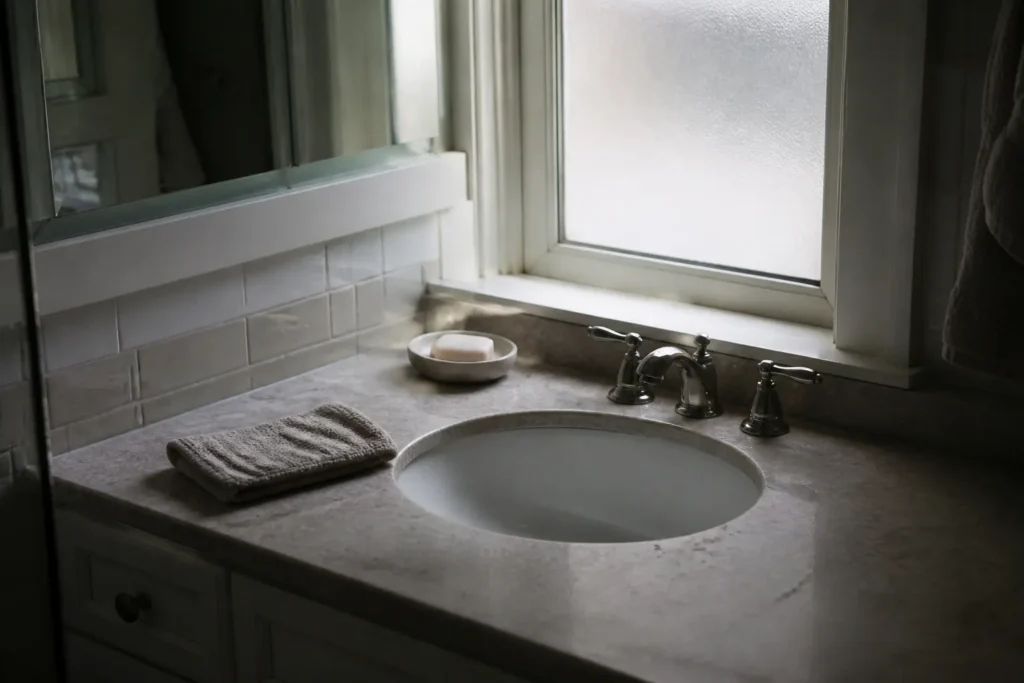
- Undermount: the counter edge runs into the bowl, so you can wipe straight in. Easiest to keep clean and the most common choice now.
- Drop-in: the rim sits on top. Cheaper, and the rim joint collects grime.
- Vessel: a bowl sitting on the surface. Striking, and it raises the effective height, which needs checking against vanity height.
- Integrated: sink and top in one piece, in solid surface or quartz. No joint at all.
Thickness
Standard stone is 2 cm or 3 cm. On a vanity, 2 cm is perfectly adequate and saves money; 3 cm reads more substantial. A mitred edge can make 2 cm look thicker.
Backsplash
A 4-inch stone backsplash protects the wall behind the faucet, which is where water actually lands. It is inexpensive and it prevents the peeling paint that shows up behind vanities after a few years.
Faucet holes
Decide before fabrication: single-hole, 4-inch centreset, 8-inch widespread, or wall-mounted with no holes at all. This cannot be changed afterwards.
Hard water, specifically
Plano water leaves mineral deposits. On a non-porous surface they wipe off. On sealed stone they bond to the sealer and need attention before they build up.
Whatever material you choose, drying the area around the faucet after use is the single habit that keeps a vanity looking new. A softener helps the whole house, not just the counter.
Remnants are worth asking about
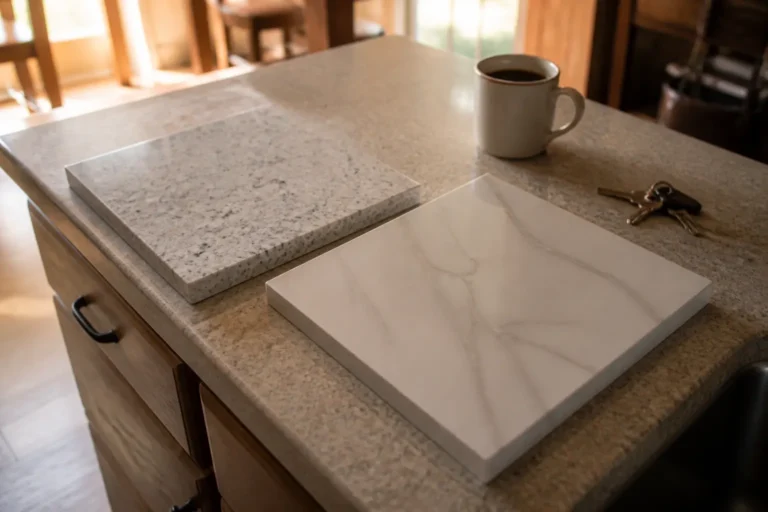
A vanity top is small. Fabricators keep offcuts from kitchen jobs, and a remnant can put a premium material on your vanity at a fraction of the full slab price. It is the easiest saving in the whole project — just ask what is in the rack.
Our bathroom countertop quotes include remnant options when we have something suitable.
Frequently asked questions
Can I use the same material as my kitchen?
You can, and it creates continuity in an open home. In a bathroom on a different floor it matters much less.
What height should a vanity be?
Thirty-two to 36 inches. Comfort height is 36 and suits most adults. A vessel sink adds its own height on top.
Does a double vanity need one piece or two?
One piece if the slab allows, which is usually up to about 8 feet. Beyond that, a seam between the two sinks is standard.
Will nail polish remover damage the counter?
Not quartz or porcelain. It can dull marble and strip granite sealer. Wipe spills promptly on natural stone.
Bring us the vanity dimensions
We will tell you what we have in remnants and what it would cost in a full slab. Call (469) 649-8119.